
If you’re looking for milk thistle tea in NZ, you’ve probably noticed it comes in several forms. There are straight milk thistle teas, concentrated extracts and botanical blends where milk thistle is one ingredient among herbs, roots, flowers and citrus.
For tea drinkers, the choice comes down to what you want in your cup.
A single-ingredient tea keeps the focus entirely on milk thistle. A botanical blend gives you more flavour to work with, balancing its earthy character with fresher, brighter or naturally sweeter ingredients.
If you want milk thistle but also want a tea you’ll look forward to making, here’s what to consider.
What is milk thistle?
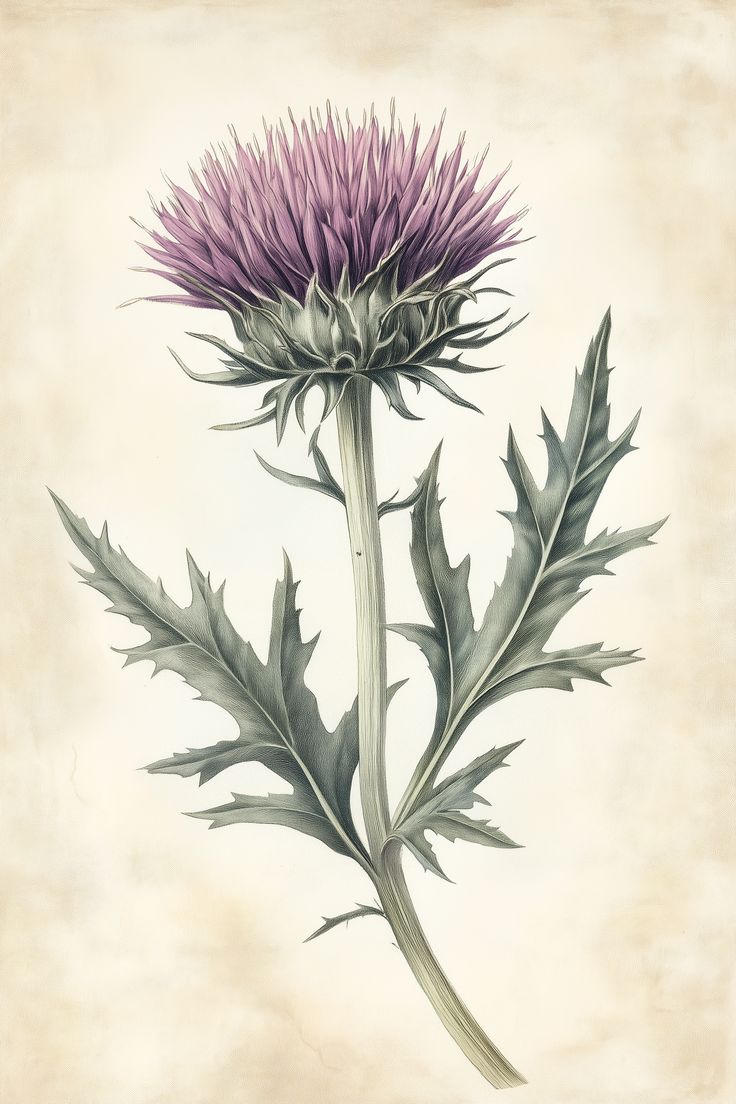
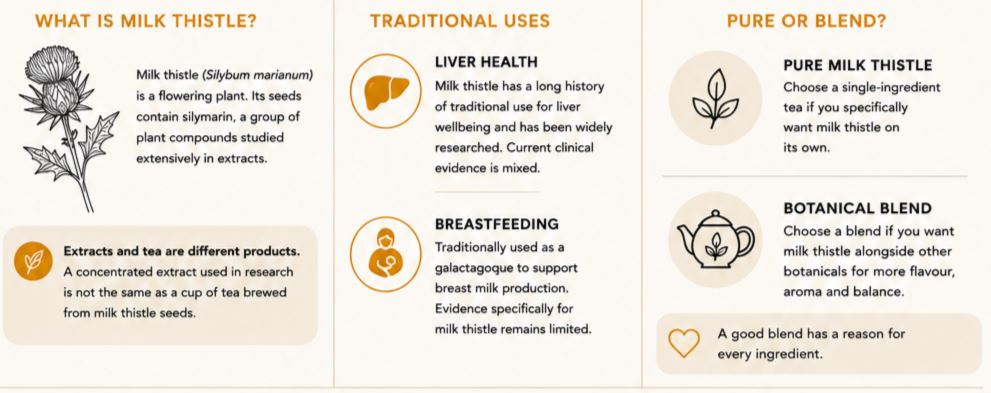
Milk thistle (Silybum marianum) is a flowering plant recognised by its purple flowers and spiny leaves.
Its fruits, commonly called seeds, contain a group of naturally occurring compounds known collectively as silymarin. Concentrated silymarin extracts are widely used in supplements and have been the focus of much of the scientific research surrounding milk thistle.
Milk thistle seeds can also be used as a botanical ingredient in tea.
That distinction is worth remembering when you read about milk thistle. A concentrated extract and a botanical infusion aren’t the same product. If you’re buying milk thistle as tea, there are other questions worth asking too: What does it taste like? What has it been blended with? And, most importantly, will you enjoy drinking it?
What is milk thistle used for?
Milk thistle has a long history of traditional herbal use, particularly in connection with liver health. That history has led to considerable modern interest in the plant and its silymarin compounds.
Milk thistle and liver health
The liver is probably the association most people have with milk thistle.
Researchers have investigated milk thistle and silymarin extracts in relation to several liver conditions. The clinical research is ongoing, with results varying between studies.
Much of that research involves concentrated extracts rather than brewed milk thistle tea, so we think it’s best to keep the two in their proper lanes.
Milk thistle is an interesting botanical with a long history of use. Tea is also allowed to simply be tea.
Milk thistle and breastfeeding
Milk thistle also has a history of traditional use during breastfeeding.
It has been used as a galactagogue, the technical term for something used with the intention of supporting breast milk production. Milk thistle and silymarin preparations have been investigated for this purpose, and LactMed documents its traditional use alongside the available research.
Evidence specifically supporting milk thistle for increasing milk production remains limited. If you’re breastfeeding and considering milk thistle specifically for milk supply, talk with your midwife, lactation consultant, pharmacist or another healthcare professional.
What does milk thistle tea taste like?
Milk thistle has an earthy, seed-like botanical character. It’s quite different from something immediately aromatic like peppermint or citrus peel.
On its own, that earthiness is part of its appeal. In a blend, it also gives you a solid base to build around.
Fresh herbs can lighten it. Citrus can add brightness. Roots can deepen the cup, while naturally sweeter botanicals can soften the finish.
This is why we like milk thistle as part of a broader blend. You still get the botanical you came looking for, but the drinking experience doesn’t have to revolve around a single flavour.
Pure milk thistle tea or a botanical blend?
There’s no complicated answer here.
Choose pure milk thistle tea if you specifically want to drink milk thistle on its own.
Choose a botanical blend if you want milk thistle alongside other flavours and aromas.
A good blend shouldn’t feel like someone emptied the herbal cupboard into a packet and hoped for the best. Each ingredient should have a reason for being there.
That’s particularly important if you want a tea for regular drinking. Interesting ingredients might persuade you to buy the first packet. Flavour is what gets you to finish it.
If you enjoy exploring individual botanicals before deciding what belongs in your cupboard, our elderflower buying guide takes a similar practical approach to choosing and using another botanical tea.
What to look for when buying milk thistle tea
Start with real ingredients
Read the ingredient list.
You should be able to tell exactly what you’re brewing. We prefer loose-leaf tea made with recognisable herbs, roots, seeds and flowers rather than unnecessary colours, sweeteners or artificial flavours.
There’s something reassuringly straightforward about opening a packet and being able to see what’s in your tea.
If colourful botanicals are more your thing, our guide to finding butterfly pea tea covers what to look for when buying that distinctive blue infusion online in New Zealand.
Consider the whole blend
Milk thistle might be the ingredient that brought you there, but look at everything accompanying it.
Peppermint brings a very different character from burdock root. Lemon myrtle behaves differently from liquorice root. Orange peel brings something different again.
The best question isn’t simply, “Does this contain milk thistle?”
It’s, “Do these ingredients sound good together?”
Think about when you’ll drink it
A botanical tea needs somewhere to fit into your day.
A naturally caffeine-free blend can work particularly well in the afternoon or evening, when another flat white or black tea might not be what you’re after.
It also comes into its own through the cooler months. On a grey Southland afternoon, or one of those spring days that looked promising until you stepped outside, a warm botanical cup makes considerably more sense than its ingredient list might suggest.
In summer, you can take the same flavour profile in another direction and try it chilled.
Don’t forget the food
Botanical tea doesn’t need to be drunk in isolation.
An earthy, minty and citrus-led blend works particularly well with foods that aren’t excessively sweet.
Try it with oat biscuits or Anzac biscuits for an afternoon cup. The sweetness of the biscuit gives the earthier botanicals some contrast without overwhelming the peppermint and citrus.
A warm cheese scone takes it in the other direction. The savoury richness works nicely against a fresher herbal cup, particularly if you’re used to automatically reaching for black tea.
For something lighter, try sliced apple or pear, toasted nuts, or a simple fruit loaf. Citrus baking is another natural fit. A piece of lemon loaf or lemon slice picks up the brighter lemon myrtle and orange notes in the blend.
Pairing tea with food is mostly about deciding whether you want complementary or contrasting flavours. We go into that in more detail in our guide to tea and desserts, using French Earl Grey as a more floral example.
And if you’re having Blend No.03 after dinner, you don’t necessarily need anything with it. Sometimes the best pairing is simply not making another coffee.
A closer look at Blend No.03
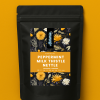
This thinking is behind Alchemix Blend No.03.
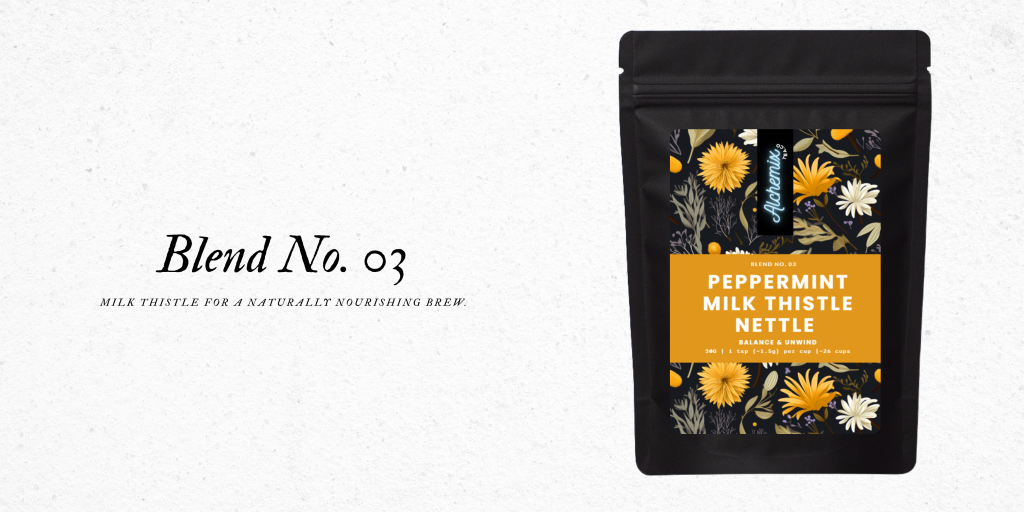
Milk thistle sits alongside burdock root, lemon myrtle, alfalfa, peppermint, liquorice root, nettle, calendula and orange peel.
It’s not intended to taste like nine separate ingredients competing for attention.
The earthier ingredients give the blend its base. Peppermint brings a clean freshness, while lemon myrtle and orange peel lift the cup with citrus character. Liquorice root contributes natural sweetness and rounds out the finish.
The result is fresh, earthy and balanced, with enough brightness to keep the cup interesting.
It’s also naturally caffeine-free, which gives it plenty of room in the day. Brew it in the afternoon, keep it for after dinner, or make a pot when the Southland weather has decided summer was only a suggestion.
Alchemix is based down here, so we’re familiar with that particular problem.
How to enjoy a milk thistle botanical blend
For a warm cup, follow the brewing directions on the packet and give the botanicals enough time to properly infuse.
Drink it straight first.
That gives you a chance to taste the peppermint, citrus, earthier botanicals and natural sweetness before deciding whether you want to change anything.
For warmer weather, brew it a little stronger, allow it to cool and serve over plenty of ice. A slice of fresh lemon or orange works naturally with the citrus side of the blend.
And if you’re serving it alongside food, keep things relatively simple. Scones, oat biscuits, fruit loaf and citrus baking all give the tea enough room to taste like itself.
Milk thistle tea FAQs
Is milk thistle tea caffeine-free?
Milk thistle itself is naturally caffeine-free. If you’re buying a blend, check the remaining ingredients as black, green and other teas made from Camellia sinensis naturally contain caffeine.
Blend No.03 is naturally caffeine-free.
Is milk thistle traditionally associated with liver health?
Yes. Milk thistle has a long history of traditional use associated with liver health and has subsequently attracted considerable scientific interest.
Modern clinical research has investigated milk thistle and silymarin extracts for several liver conditions, although results vary and research is continuing.
Is milk thistle used while breastfeeding?
Milk thistle has traditionally been used as a galactagogue, meaning something used with the intention of supporting breast milk production.
Its breastfeeding use is documented by LactMed, although evidence specifically supporting milk thistle for increasing milk supply remains limited.
If you’re breastfeeding and considering it specifically for milk production, speak with an appropriate healthcare professional.
Is milk thistle tea the same as a supplement?
No. Supplements can contain concentrated or standardised extracts, while milk thistle tea is an infusion made in water.
Research involving a concentrated silymarin preparation therefore isn’t directly equivalent to drinking a cup of botanical tea containing milk thistle.
What foods go with milk thistle tea?
With an earthy, minty and citrus-led botanical blend, try oat or Anzac biscuits, a cheese scone, fruit loaf, fresh apple or pear, or citrus baking such as lemon loaf.
For an after-dinner cup, it’s also perfectly capable of flying solo.
Can I drink milk thistle tea cold?
Yes. A botanical milk thistle blend can be served chilled as well as hot.
Brew it a little stronger before cooling so the flavour holds up once you add ice. A fresh slice of lemon or orange is an easy addition.
Where can I buy milk thistle tea in New Zealand?
If you want pure milk thistle, look for a single-ingredient product.
If you’d prefer milk thistle as part of a more rounded loose-leaf tea, Alchemix Blend No.03 combines it with eight other botanicals to create a fresh, earthy and naturally caffeine-free cup.
Milk thistle, blended for drinking
Milk thistle might be what starts the search, but it doesn’t have to be the only thing in the cup.
Blend No.03 pairs it with peppermint, lemon myrtle, burdock root, liquorice root and other real botanicals to create something fresher, brighter and more interesting to drink.
Have it hot with a cheese scone on a cold afternoon. Pour it over ice when summer finally commits. Or keep it straightforward and make a cup after dinner.
Explore Blend No.03 if you’re looking for milk thistle in a botanical tea that’s been built around flavour, not just the ingredient on the label.
Related Articles





-
Blend No.02 - Rose, Raspberry Leaf, Acai, Goji
$ 15.99 – $ 42.00 -
Matcha Scoop
$ 7.00 -
Blend No.03 - Peppermint, Milk Thistle, Nettle
$ 15.99 – $ 42.00 -
Fine Mesh Matcha Sieve
$ 12.00 -
Blend No.01 - Calendula, Hibiscus, Yerba Mate
$ 15.99 – $ 42.00
 We do loose leaves that you can taste and non of that dusty stuff in a bag.